LHCb Exhibition
Hints for new particles and forces?
Experiments at CERN investigate elementary particles and fundamental forces, but also search for the unknown. In March 2021, indications for something new was found at the LHCb experiment: some particles do not behave quite as expected.
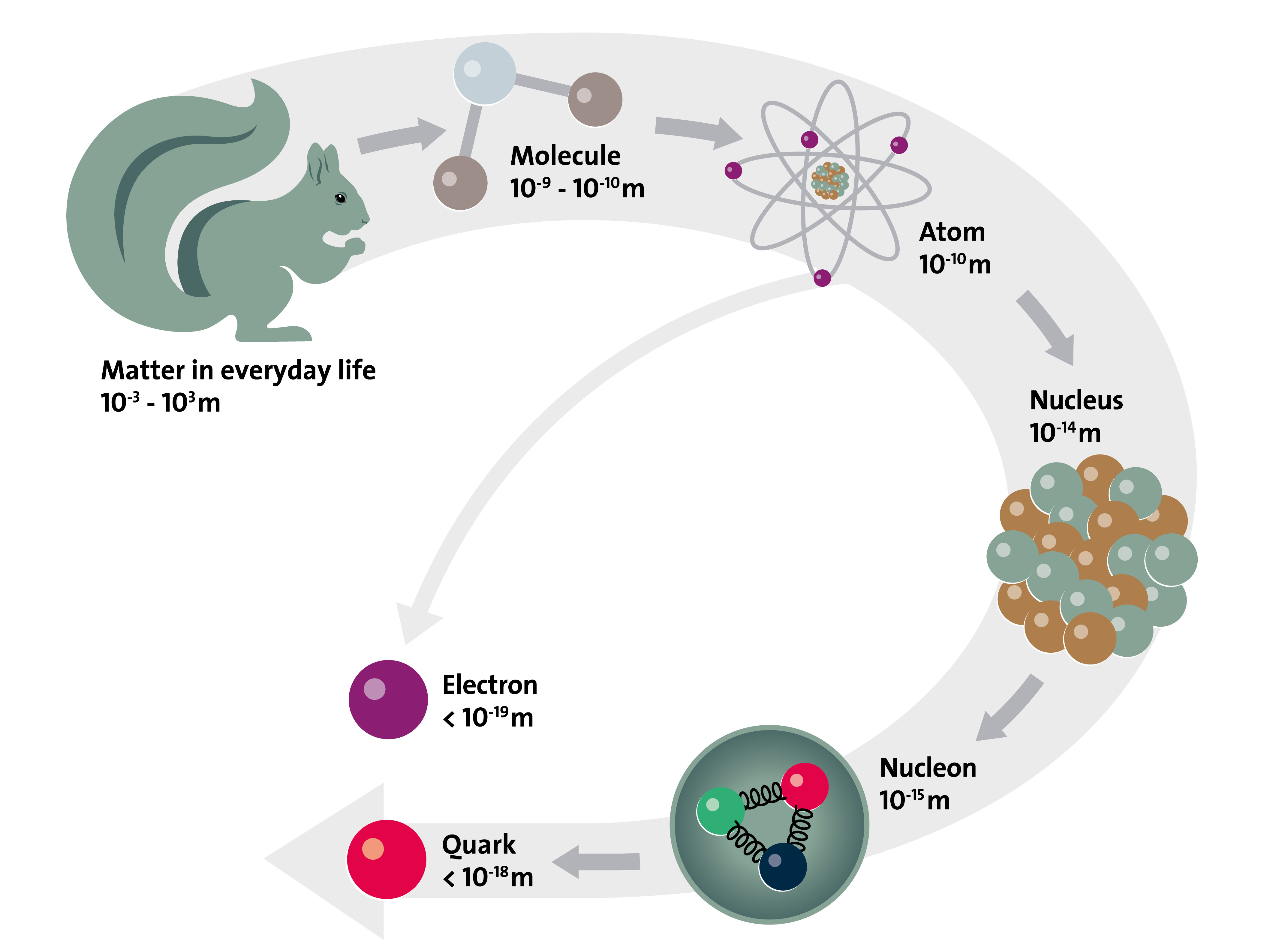
In physics we know four fundamental forces: 1. Gravitation (formation of galaxies and the movement of planets); 2.Electromagnetism (bonding of atoms and molecular bonds); 3. The weak interaction (fusion processes ); 4. The strong interaction (bonding of the nucleus, protons and neutrons).

The Standard Model of Particle Physics
The Standard Model of particle physics describes all - currently known and experimentally confirmed - elementary particles, the electromagnetic, weak and strong interactions, as well as the Higgs mechanism, which explains how particles obtain their masses.
Each interaction is transmitted by a so-called force particle. Each particle has specific properties such as mass, charge and spin, which is the intrinsic angular momentum of the particle. Today we know of three negatively charged, three neutral particles and six quarks; three with charge +2/3 and three with charge -1/3. For each of these particles an anti-particle also exists, which carries exactly the opposite charge.

- Protons consist of two up quarks and one down quarks, neutrons of two down quarks and one up quark
- All matter that we know of (galaxies, stars, the earth and us) consists of electrons, up quarks and down quarks. All other elementary particles (apart from neutrinos) are not stable.
- Quarks and anti-quarks can build many other short-lived particles, for example mesons consisting of a quark and an anti-quark.
- The photon transmits the electromagnetic force, it is neutral and massless.
- Gluons transmit the strong interaction.
- W and Z bosons transmit the weak interaction.
Interesting to know
Muons, the heavy siblings of electrons, are continuously flying through us. They are created in the atmosphere by collisions of particles from space - mainly protons - with the atoms in the atmosphere.
The Standard Model - successful but incomplete
The standard model was essentially developed in the years 1961-1973. It describes the building blocks of the universe and their interactions. Until today the predictions are in excellent agreement with the experimental findings. But there are still many open questions.
What is Dark Matter
Many different cosmological observations show that there is about four times more matter in the universe than what we can account for with ordinary matter. For example, stars in many galaxies are moving too fast. Stars rotate around the galactic centre, which is also where most of the galaxy's mass is located. Since the gravitational force weakens with greater distance, the rotation speed should decrease towards the edge of the galaxy. In fact, in many galaxies the speed of the stars remains constant or even increases. This behaviour can be explained if there is more matter than the visible matter - so called dark matter.

Why is there more matter than antimatter?
Particles and anti-particles annihilate when they meet and become energy. During the big bang, the same amount of matter as antimatter was created from energy, but only matter is observed today. A tiny surplus - about 1 particle surplus on 1 billion particle-antiparticle-pairs - in the early universe resulted in the triumph of matter over anti-matter. This asymmetry cannot be explained by the Standard Model.
Interesting to know:
The radiation produced by the annihilation of antimatter can still be measured today.

What about gravity?
The comparatively very weak gravitational force is the only fundamental interaction not described by the Standard Model.

Where to search?
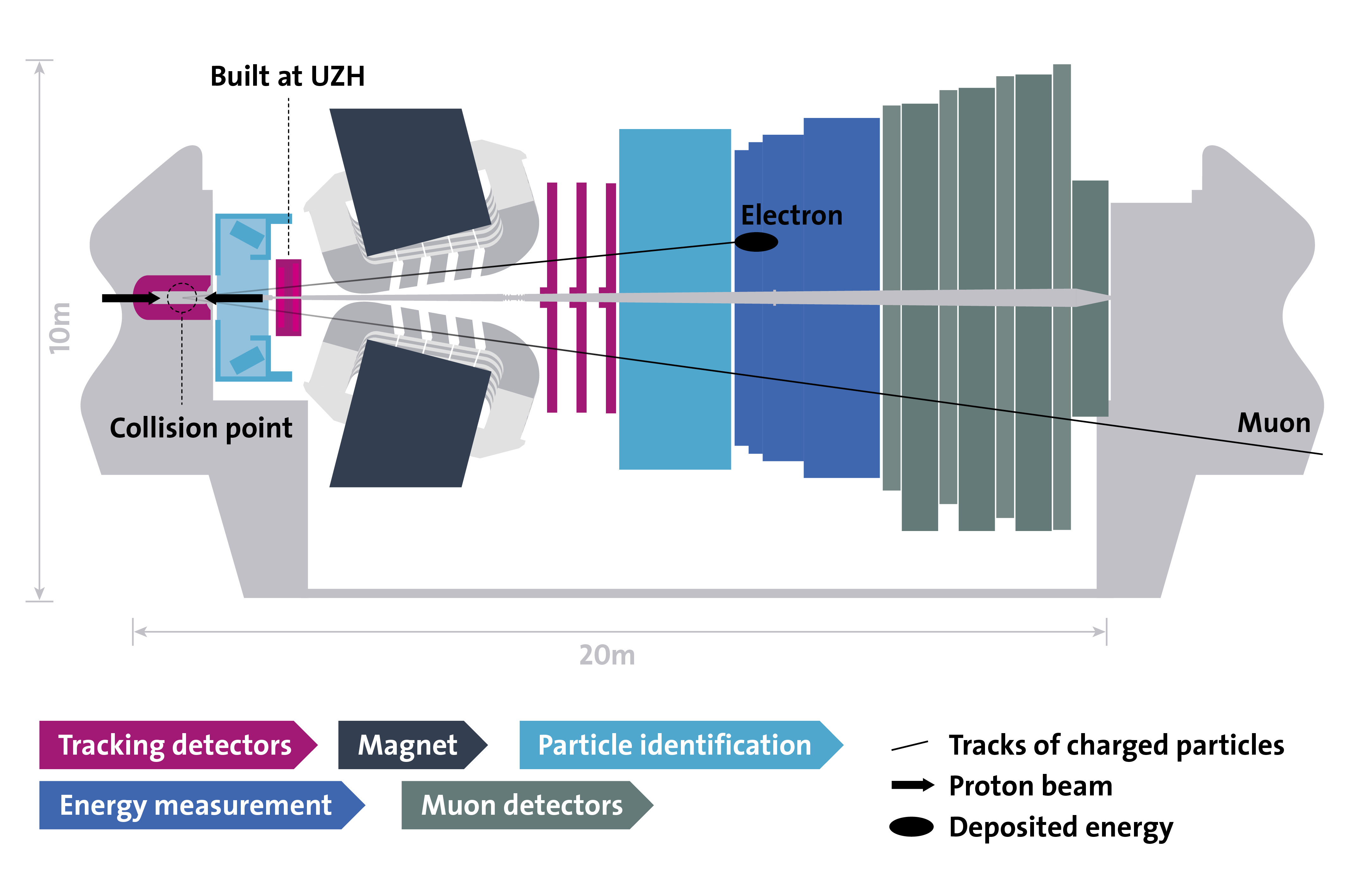
Currently, the largest accelerator (Large Hadron Collider, LHC) is located at CERN in Geneva. There, protons are accelerated to almost the speed of light and brought to collision at four points. UZH researchers are involved in the CMS and LHCb experiments, where they search directly for new particles or indirectly for possible effects of new particles or forces.

Intriguing results
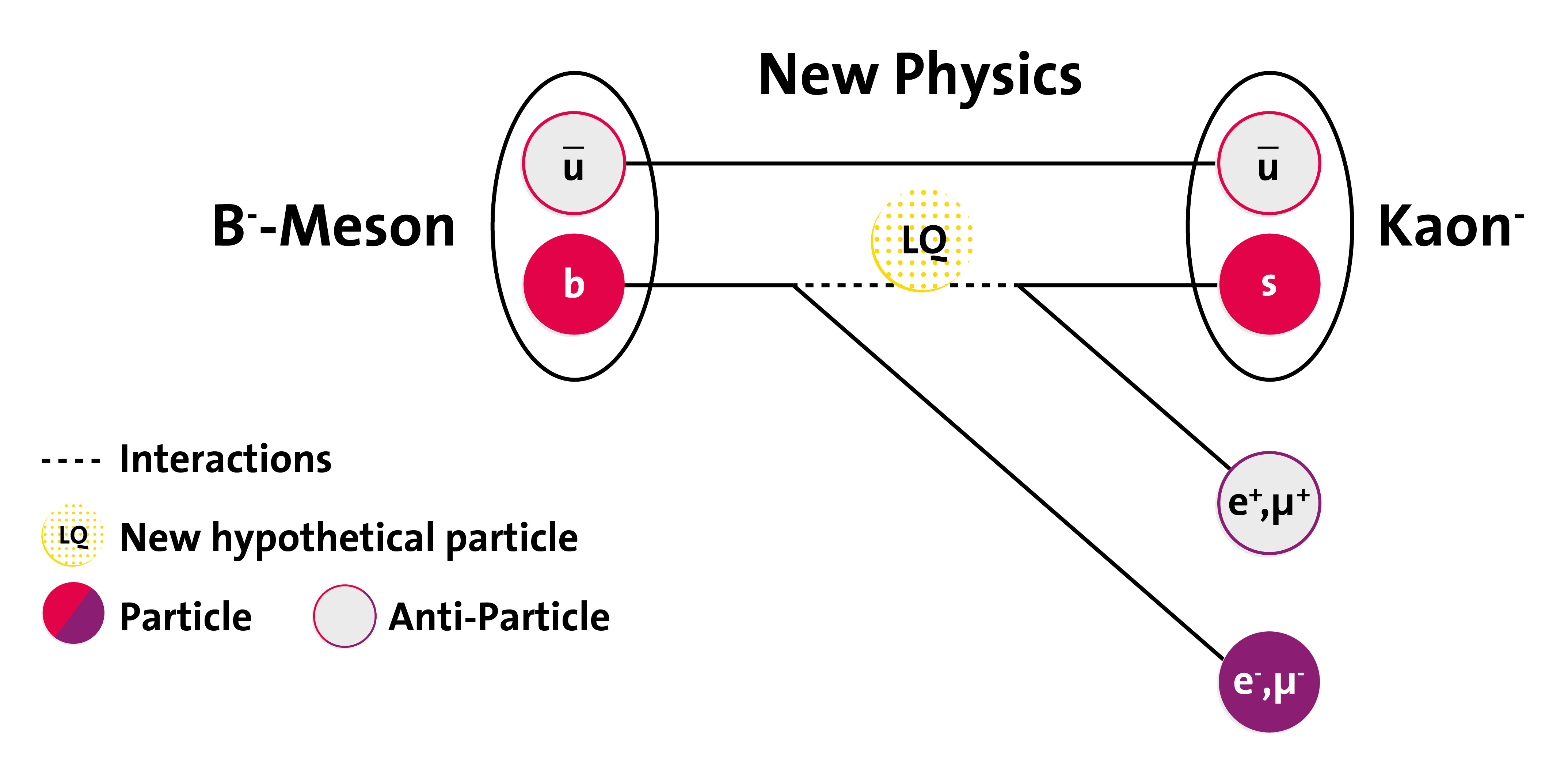
The LHCb experiment is designed to investigate why an excess of matter was created after the Big Bang and to search for new particles and forces. UZH researchers in Professor Nicola Serra's group are at the forefront of this effort. For example, they are investigating the transformation of a negatively charged B meson consisting of a bottom quark and an anti-up quark. Very rarely a pair of electrons or muons are produced in this transformation.

In the Standard Model, muon and electron pairs should be equally abundant in the final state, since they differ only in their masses but not in their interactions. Some recent LHCb measurements indicate that the decays of B mesons into muons are less frequent than expected by the Standard Model.
What does it mean?
The researchers do not know yet - the precision of the measurement does not yet allow a firm statement. To be sure, more data is needed and also the analysis of processes with other particles in the initial or final state or the angular distribution of the electron and muon pairs
How could new particles or forces explain the measurements?
The research group of UZH Professor Gino Isidori is working on theoretical models that could explain the unexpected measurements.
One explanation could be that a new, very heavy particle is produced in the decay, a hypothetical leptoquark, which would be an indication of a fifth force. This leptoquark can couple to quarks as well as to leptons (electrons or muons, among others). The particles in the final state are the same as in the Standard Model - a kaon and an electron or muon pair, but their abundance, energy and angular distribution may be slightly different.
Researchers

Dr. Patrick Owen (left)
Experimental particle physics
From Great Britain, at UZH since 2016
Patrick Owen is Senior Scientist in the research group of Nico Serra and leads the LHCb analysis on lepton universality.
Prof. Dr. Gino Idisory (middle)
Theoretical particle physics
From Italy, at UZH since 2014
The research activity of the group of Gino Isidori deals with some of the most interesting open questions about the nature of basic constituents of matter and their fundamental interactions, for example the mass of elementary particles, the possible unification of fundamental forces and the origin of dark matter.
Prof. Dr. Nicola Serra (right)
Experimental particle physics
From Italy, at UZH since 2013
Prof. Serra is the leader of the UZH LHCb group. His research interests are mainly studies of rare decays of B-mesons, lepton flavour violating decays of B-mesons and tau leptons and search for very weakly interacting particles, in particular searches for sterile neutrinos.