For experts: Higgs Particle
The problem with the mass
In the 1960s, researchers in particle physics were faced with a problem as the early Standard Model could not explain the mass of elementary particles. But without mass, electrons could not be bound in atoms and while the force particles of the electromagnetic and strong interactions are massless, the force carriers of the weak interaction have a very large mass, the reason why this interaction very short-ranged.
Some theorists - including Brout, Englert and Higgs - proposed an extension to the theoretical model. They introduced a new field that penetrates the entire universe, the so-called Higgs field. Particles acquire their mass by interacting with this field: the stronger the interaction, the larger the mass of the particle.
This field is associated with a new particle, the Higgs particle, for which the search has been on since the 1960s. The Higgs particle is created when heavy particles such as top quarks, W or Z particles move through the Higgs field with high energy and can be produced at the LHC collider.

Measurement of CMS showing the strength of the coupling of the Higgs particle to elementary particles. The y axis is the strength of the interaction the x axis the mass of the particles (Image: https://twiki.cern.ch/twiki/bin/view/CMSPublic/PhysicsResultsHIG).
Discovery of the Higgs particle
In 2012, the Higgs particle was discovered at the two LHC experiments ATLAS and CMS experiments, thereby confirming the theorists' hypothesis of how elementary
elementary particles acquire their mass. Since the particle is very heavy
(125 gigaelectronvolts) and decays quickly (in about 10-22 s), it is not so easy to detect.
The properties of the new particle have over the last 10 years been measured with increasing precision and have so far been close to the expectations.
Peter Higgs and François Englert were awarded the Nobel Prize in Physics in 2013 for the theoretical prediction of the Higgs boson.
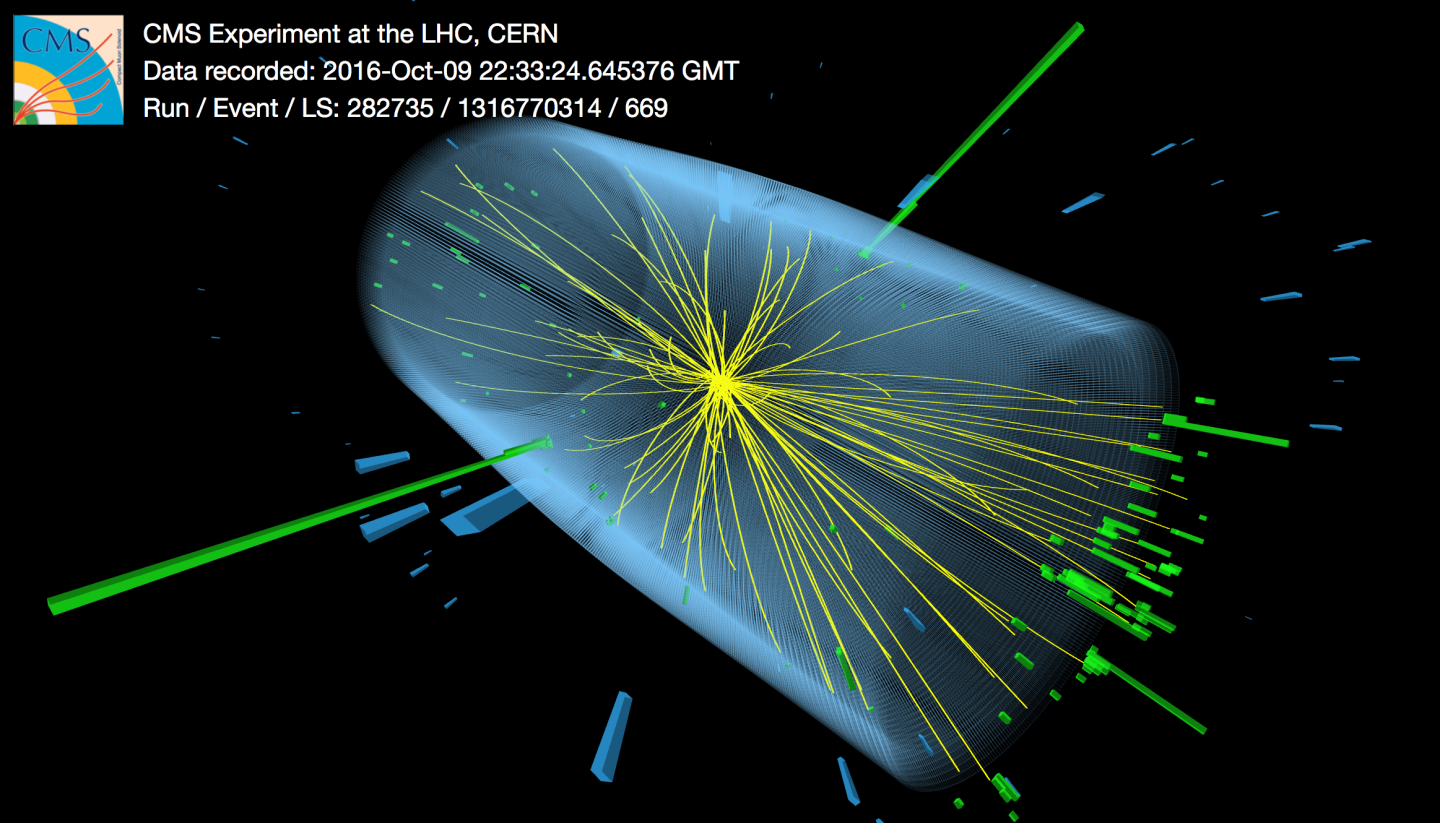
A candidate from CMS of a Higgs boson transforming into two photons; the two large green towers show energy deposits from the photons (Image: Thomas McCauley, CMS/CERN)